


Whether it's a robot vacuum navigating through a home, a commercial floor scrubber operating in shopping malls and warehouses, a robotic lawn mower working outdoors, or a pool cleaning robot running underwater, all cleaning robots rely on one critical component: the battery.
Battery performance directly determines runtime, reliability, safety, and overall operating costs.
Choosing the wrong battery pack can lead to:
This guide explores six key factors to help OEMs and robot manufacturers select the most suitable battery solution for their cleaning robot applications.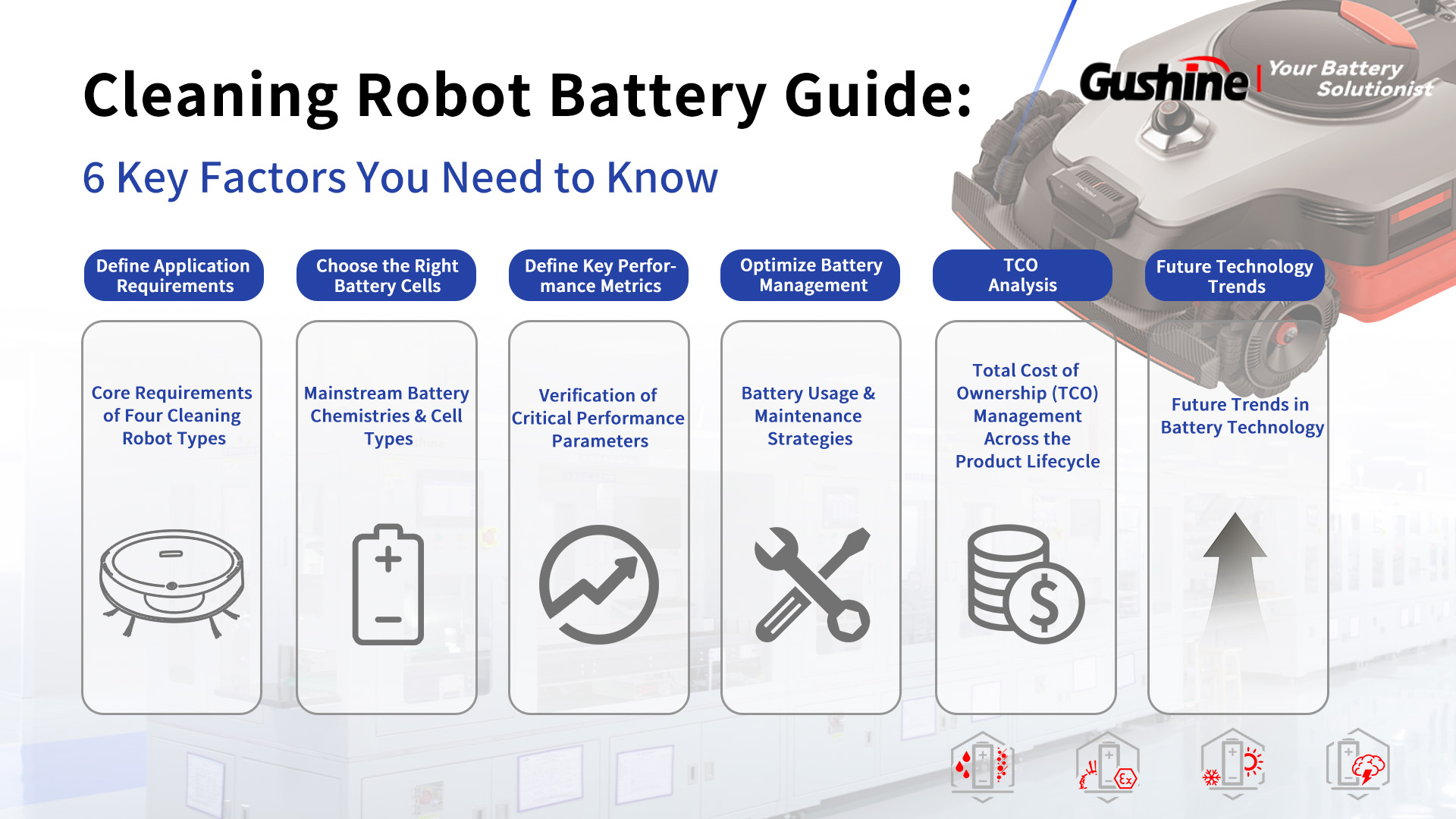
Different types of cleaning robots place different demands on battery systems.
|
Robot Type |
Operating Environment |
Key Battery Priorities |
|
Robot Vacuum Cleaner |
Indoor flooring, carpets, tiles |
Safety → Runtime → Cost → Size & Weight |
|
Commercial Floor Scrubber |
Shopping malls, hospitals, warehouses, factories |
Cycle Life → Fast Charging → Safety → Total Cost of Ownership |
|
Outdoor lawns, exposed to sun, rain, vibration |
Environmental Durability → Safety → Runtime → Peak Power |
|
|
Pool Cleaning Robot |
Underwater operation |
Waterproofing → Safety → Energy Density → Low Self-Discharge |
Understanding the operating environment is the first step toward selecting the right battery architecture.
For today's cleaning robots, two lithium battery chemistries dominate the market: Lithium Iron Phosphate (LiFePO₄) and Lithium-Ion (NMC/LCO).
|
Battery Chemistry |
Energy Density (Wh/kg) |
Cycle Life |
Safety |
Cost |
Typical Applications |
|
100–160 |
2,000–6,000 cycles |
Excellent |
Medium |
Robot vacuums, commercial floor scrubbers, premium lawn mowers |
|
|
250–300 |
500–1,000 cycles |
Moderate |
Medium-High |
Compact robot vacuums, lawn mowers, pool cleaners |
LiFePO₄ batteries are increasingly becoming the preferred solution for robot vacuums due to their outstanding thermal stability, long cycle life, and superior safety characteristics. They are particularly suitable for products that remain on charging docks for extended periods.
For manufacturers pursuing ultra-thin designs or extended runtime within limited space, NMC battery solutions remain a viable option.
LiFePO₄ is widely considered the optimal choice for commercial cleaning equipment. Its long service life and excellent thermal stability significantly reduce replacement frequency and operating costs.
Both NMC and LiFePO₄ batteries are commonly used.
NMC batteries provide higher energy density, while LiFePO₄ offers enhanced safety and longer lifespan. For products targeting European and North American markets, safety certifications and environmental durability often become key selection factors.
Battery packs should also provide:
Pool cleaning robots typically favor high-energy-density lithium-ion batteries to support extended underwater operation.
In these applications, waterproof design is often more critical than battery chemistry itself. IP68 protection, sealed battery enclosures, and waterproof connectors are essential.
After selecting a battery chemistry, manufacturers should establish measurable performance targets.
|
Parameter |
Robot Vacuum |
Commercial Floor Scrubber |
Lawn Mower Robot |
Pool Cleaning Robot |
|
Runtime |
90–150 min |
≥4 hours |
60–150 min |
Around 2 hours |
|
Battery Capacity |
4,000–6,000mAh+ |
48V 30–60Ah |
4,000–10,000mAh |
Around 5,000mAh |
|
Voltage |
12.8V–25.6V (LiFePO₄ 4S–8S) 14.4V–28.8V (NMC 4S–8S) |
24V–72V (7S–20S) |
18V–28.8V (5S–8S) |
12.8V–25.6V (4S–8S) |
|
Cycle Life |
≥2,000 cycles |
≥2,000 cycles |
≥800 cycles |
500–800 cycles |
|
Charge Rate |
0.5–1C |
1.5–2C Fast Charging |
0.5–1C |
0.5C |
|
Peak Discharge |
2–3C |
2C |
≥3C |
2–3C |
|
Operating Temperature |
0–40°C |
-10–50°C |
-10–50°C |
0–40°C |
|
Protection Level |
IPX4 |
IPX4–IPX5 |
IPX5–IPX6 |
IP68 |
For outdoor and underwater applications, real-world testing remains essential because runtime can vary significantly depending on operating conditions.
Selecting the right battery is only part of the equation. Intelligent battery management can dramatically improve service life and operational efficiency.
Recommended charging strategy:
Application-specific considerations:
Robot Vacuums & Floor Scrubbers
Accurate state-of-charge estimation is critical, particularly for LiFePO₄ batteries, which have a relatively flat discharge curve.
Outdoor charging stations should incorporate:
For seasonal storage, batteries should be maintained at 40–60% charge and recharged periodically.
Pool Cleaning Robots
Magnetic waterproof charging interfaces and automatic power isolation improve both reliability and safety.
Advanced battery management systems (BMS) can further improve efficiency by:
Modern BMS platforms typically integrate overcharge, over-discharge, overcurrent, short-circuit, and temperature protection while supporting communication protocols such as I²C, SPI, CAN, or RS485.
The lowest purchase price does not always translate into the lowest long-term cost.
Manufacturers should evaluate:
|
Application |
Long-Term Cost Priority |
Recommended Battery Design |
|
Robot Vacuum |
Minimize replacement frequency |
LiFePO₄ + user-replaceable design |
|
Floor Scrubber |
Maximize cycle life |
LiFePO₄ + modular hot-swappable battery |
|
Lawn Mower Robot |
Easy field replacement |
Modular battery with waterproof enclosure |
|
Pool Cleaning Robot |
Prevent water ingress failures |
Fully sealed battery module |
Reliable supply chain capability is also becoming increasingly important. Manufacturers with multiple production bases can better mitigate geopolitical and logistics risks while ensuring stable delivery schedules.
Several emerging technologies are expected to reshape the cleaning robot industry over the next five years.
Solid-state technology may increase energy density to 400–500 Wh/kg, enabling significantly longer runtime without increasing battery size.
Future robots will leverage AI algorithms to predict energy consumption, optimize cleaning routes, and schedule charging more efficiently.
Some robotic lawn mowers are already integrating solar charging panels to supplement standby power consumption.
Wireless charging solutions may eliminate exposed charging interfaces, improving waterproof performance and reducing maintenance requirements for outdoor and underwater robots.
|
Robot Type |
Recommended Battery Chemistry |
Typical Runtime |
Key Protection Requirements |
|
Robot Vacuum |
LiFePO₄ |
90–150 min |
Accurate SOC estimation, thermal protection |
|
Commercial Floor Scrubber |
LiFePO₄ |
≥4 hours |
Advanced BMS, CAN communication |
|
Robotic Lawn Mower |
NMC or LiFePO₄ |
60–150 min |
Waterproofing, vibration resistance, wide-temperature protection |
|
Pool Cleaning Robot |
Lithium-Ion + IP68 Design |
Around 2 hours |
Fully sealed waterproof battery system |
Yes. LiFePO4 batteries are particularly well suited for premium robot vacuums that require high safety, long service life, and reliable performance. Compared with conventional lithium-ion chemistries, LiFePO4 offers enhanced safety, longer cycle life, better thermal stability, and more consistent performance under frequent charging and extended standby conditions. This makes it ideal for robot vacuums that remain docked and recharge regularly.
The cycle life depends on the battery chemistry used.
Actual battery life is also influenced by factors such as charging strategy, BMS performance, operating temperature, and the robot's power consumption.
Yes. Cleaning robots often operate in environments exposed to water tanks, wet mops, moisture, and humidity. Battery packs should incorporate appropriate moisture and water-resistant protection, along with effective sealing, insulation, and BMS safeguards to reduce the risks of water ingress, short circuits, and corrosion.
There is no universal battery solution for every cleaning robot.
The ideal battery depends on the operating environment, performance expectations, safety requirements, and total lifecycle cost.
For robot vacuums, the focus is often safety and runtime. Commercial floor scrubbers prioritize long cycle life and fast charging. Outdoor and underwater robots require robust environmental protection and reliable power delivery.
As a custom lithium battery pack manufacturer with over 15 years of experience, Gushine has delivered more than 3,500 battery projects across robot vacuums, commercial cleaning equipment, AGV/AMR systems, and other intelligent devices. With manufacturing bases in China and Vietnam and comprehensive customization capabilities covering cells, BMS, and pack integration, Gushine supports OEMs in developing reliable and scalable battery solutions for next-generation cleaning robots.


 Select a language