


“How long do lithium batteries last?” is one of the first questions customers ask when evaluating battery-powered products.
The answer, however, is not a fixed number. Lithium battery cycle life is the result of multiple interacting factors, including cell chemistry, battery management system (BMS) design, and real-world operating conditions. As a professional lithium battery pack solution provider, Gushine explains what truly determines lithium-ion battery lifespan—and how customized system design can significantly extend it.
Lithium Battery Cycle Life is the number of full charge–discharge cycles a battery can deliver before its capacity drops to about 80% of the original rating.
One full cycle represents a complete discharge from 100% to 0% and a recharge back to 100%. In practice, partial usage (for example, discharging 30% and recharging 30%) counts as a fraction of a full cycle.
Typical industry benchmarks include:
It is important to note that these figures reflect cell-level performance under controlled conditions. The actual life of a lithium battery pack depends on several critical system-level factors.
Selection depends on application priorities, such as lifespan, energy density, space constraints, and safety requirements.
Cells from mature, well-controlled supply chains provide better batch consistency and more predictable aging behavior—an essential foundation for long-lasting battery systems.
Frequent fast charging or high-current discharge increases internal stress and accelerates aging.
Repeated deep cycles (0–100%) shorten battery lifespan compared to operating within a moderate range such as 20–80%.
A well-designed BMS plays a decisive role in extending lithium-ion battery life by:
In many applications, an optimized BMS can significantly extend the practical lifespan of rechargeable lithium-ion batteries beyond the theoretical limits of the cells alone.
Robust mechanical design helps prevent micro short circuits caused by vibration or impact. Effective thermal management—using thermal interface materials, heat spreaders, or airflow design—ensures heat is dissipated evenly and prevents localized overheating. In medium- to high-power applications, thermal management often defines the upper limit of battery life.
As a specialist in custom lithium battery packs, Gushine integrates all lifecycle factors into a forward-looking system design approach.
At the early project stage, Gushine works closely with customers to evaluate:
Whether selecting long-life LFP cells, high-energy NMC cells, or other advanced chemistries, recommendations are based on rigorous technical evaluation. All cells are sourced from qualified suppliers and undergo strict incoming inspection and matching.
Based on power demand and environmental conditions, Gushine offers:
Using customer-provided load profiles—including current levels, duty cycles, and ambient temperature variation—Gushine can simulate expected battery lifespan during the design phase.
Comprehensive testing capabilities, such as cycle life testing and high/low-temperature performance validation, are used to verify design assumptions and ensure delivered products meet lifetime expectations.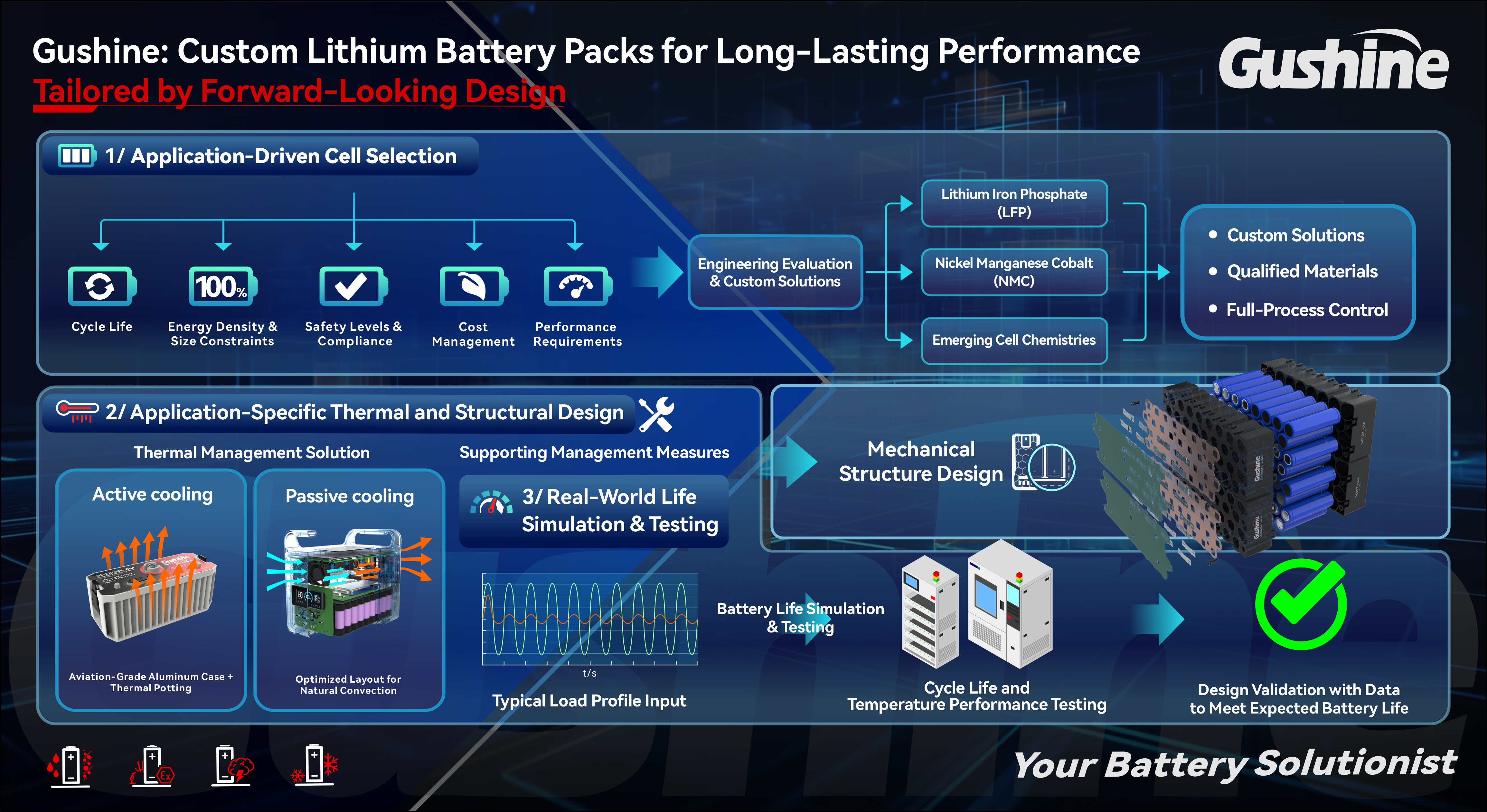
So, how long do lithium batteries last?
The answer depends on the combination of cell fundamentals, operating conditions, and system-level design.
Long-lasting lithium-ion battery systems are not accidental—they result from informed engineering decisions and a deep understanding of real-world applications. Choosing a more durable battery means lower maintenance frequency, reduced total cost of ownership, and long-term reliability.
Gushine delivers not only high-quality lithium battery packs, but also full-lifecycle technical support covering application simulation, lifespan prediction, and safety assessment.
If you have specific application requirements or lifespan targets, contact the Gushine engineering team. Together, we can design a rechargeable lithium-ion battery system that balances performance, safety, and durability.

 Select a language

 Analysis of Gushine's Standardized POS Terminal Lithium Battery Pack Solution